

Have you ever found yourself repeating the same experience, even when you genuinely want something different?
Perhaps you keep saying yes when you want to say no.
You find yourself overworking even when you promise yourself you will slow down.
You seek approval even though you know your worth shouldn’t depend on what other people think.
Or perhaps the same relationship dynamics seem to appear again and again, just with different people.
When this happens, we often focus on the most obvious part of the problem:
the behaviour.
We tell ourselves:
I need to stop doing this.
I need to be more confident.
I need better boundaries.
I need to stop overthinking.
But what if the behaviour is only the final part of the pattern?
What if something deeper is driving it?
Look Beneath the Behaviour
Imagine someone who constantly says yes to other people, even when they are exhausted.
From the outside, the solution might seem simple:
Learn to say no.
But beneath that behaviour may be an entirely different story:
If I disappoint people, they won’t like me.
My needs aren’t as important as everyone else’s.
Being helpful is what makes me valuable.
Conflict isn’t safe.
If the underlying story remains unchanged, simply trying to change the behaviour can feel incredibly difficult.
The person may say no once, but then experience guilt.
They may set a boundary, but immediately worry that they have upset someone.
Eventually, they return to the familiar behaviour.
Not because they don’t know better.
But because the deeper story is still operating.
The Story Shapes the Pattern
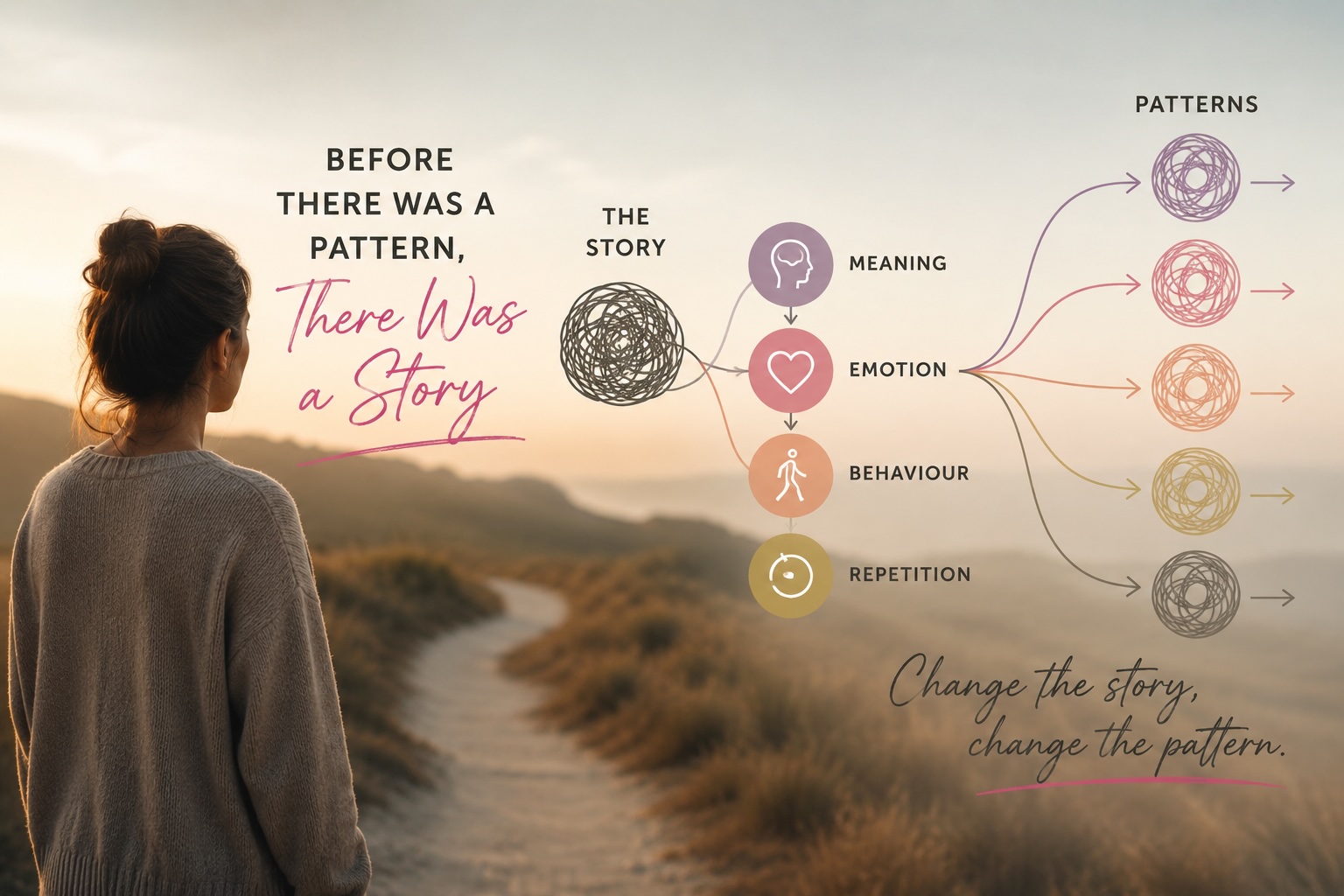
Our internal stories influence the meaning we give to experiences.
That meaning can influence how we feel.
How we feel influences how we respond.
And when the same response happens repeatedly, it can become a pattern.
It might look something like this:
Story → Meaning → Emotion → Behaviour → Repetition
For example:
Story: I have to prove my worth.
Meaning: If I’m not achieving, I’m failing.
Emotion: Anxiety and pressure.
Behaviour: Overworking and difficulty resting.
Repetition: Exhaustion, followed by another cycle of trying harder.
Or:
Story: People eventually leave.
Meaning: I need reassurance that I’m still loved.
Emotion: Fear and insecurity.
Behaviour: Seeking constant validation.
Repetition: Relationship tension that reinforces the original fear.
Suddenly, what looked like a simple behaviour begins to make much more sense.
Patterns Often Have a Purpose
This is where curiosity becomes more useful than criticism.
Instead of looking at a pattern and thinking:
“Why am I like this?”
Try asking:
“What might this pattern be trying to do for me?”
People-pleasing may be trying to maintain connection.
Perfectionism may be trying to prevent criticism.
Procrastination may be protecting you from the possibility of failure.
Avoiding difficult conversations may be trying to keep you safe from conflict.
Overworking may be connected to a need to feel valuable or secure.
This doesn’t mean every behaviour should continue.
It simply means that understanding its purpose can give you a very different starting point for change.
Awareness Interrupts the Cycle
A pattern feels automatic when we cannot see what is driving it.
But once you begin noticing the sequence, you create a space between the trigger and your usual response.
You might notice:
I’m about to say yes, but I actually want to say no.
I’m seeking reassurance because I’m afraid of being rejected.
I’m pushing myself harder because part of me believes resting means I’m lazy.
That moment of awareness matters.
Because now you are no longer simply inside the pattern.
You are observing it.
And when you can observe a pattern, you have an opportunity to respond differently.
Changing the Story
Changing a pattern isn’t simply about replacing one behaviour with another.
Sometimes we need to examine the belief or meaning underneath it.
Instead of:
I must keep everyone happy.
Perhaps:
I can care about other people without abandoning my own needs.
Instead of:
I have to prove my worth.
Perhaps:
My worth is not determined by how much I achieve.
Instead of:
Conflict means something is wrong.
Perhaps:
Healthy disagreement can be part of an honest relationship.
A new belief doesn’t become automatic simply because we say it once.
But questioning an old story creates room for another possibility.
And each time you respond differently, you begin giving yourself new evidence.
You Are Not the Pattern
Perhaps one of the most important things to remember is this:
A pattern is something you learned. It is not who you are.
You may have repeated it hundreds of times.
You may have lived with it for years.
It may feel so familiar that it seems like part of your personality.
But familiarity does not make something permanent.
The goal isn’t to judge the old pattern or fight against yourself.
It is to understand what has been happening beneath the surface and ask whether that story still belongs in the life you want to create.
Because before there was a pattern, there was a story.
And when you become aware of the story, you create the possibility of choosing something different.
A Question for Reflection
Think of one pattern that keeps appearing in your life.
Instead of asking:
“How do I stop doing this?”
Try asking:
“What would I have to believe about myself, other people, or the world for this behaviour to make sense?”
Sit with that question for a moment.
The answer may reveal something much deeper than the behaviour itself.
Ready to Explore the Patterns Holding You Back?
Through NLP Coaching, transformational coaching and guided self-discovery, I help people explore the unconscious beliefs, meanings and emotional patterns that may be influencing how they think, feel and respond.
Together, we can bring greater awareness to what is happening beneath the surface and explore new ways of responding that better support the life you want to create.
The journey can begin with a simple question:
What story has been shaping your life without you realising it?