


When something hurts, our natural response is to want it to stop.
We want the anxiety to disappear.
We want the exhaustion to lift.
We want the pain to go away.
We want to sleep better, feel calmer, have more energy and get back to being ourselves.
And understandably, much of our attention goes towards the symptom.
How do I get rid of this?
But sometimes there is another question worth asking:
What might this symptom be telling me?
Looking Beyond the Symptom
A symptom matters.
It deserves to be taken seriously, and physical or psychological symptoms can have many causes that require appropriate professional assessment and treatment.
But addressing a symptom and understanding what may be contributing to it are not always the same thing.
Imagine a smoke alarm going off in your house.
You could find a way to silence the alarm.
And sometimes, silencing it temporarily may be necessary.
But you would probably also want to know:
Why did the alarm go off in the first place?
Our experiences as human beings can be viewed in a similar way.
Sometimes what appears on the surface is only one part of a much bigger picture.
We Are More Than Our Physical Bodies
One idea I find valuable in the Abraham Hicks quote is the invitation to think about health and wellbeing more broadly.
Whether or not you use the word vibration, we know that human beings are not simply collections of physical symptoms.
Our thoughts, emotions, relationships, environment, behaviour, sleep, stress, beliefs and physical health continually interact.
Think about what happens when you’re nervous.
Your heart might beat faster.
Your stomach may tighten.
Your breathing changes.
Your muscles tense.
Nothing imaginary is happening.
A thought or perception has created a very real physiological response.
The reverse can happen too.
When you’re exhausted, hungry, unwell or in pain, your emotional state and the way you interpret the world can change.
Mind and body are not two completely separate experiences.
They influence one another constantly.
What Does “Vibrational” Mean?
In spiritual teachings, you may hear people talk about energy, frequency or vibration.
These words can mean different things to different people.
For some, vibration describes an internal state: the emotional and energetic quality of how we are experiencing life.
Fear feels different from love.
Resentment feels different from gratitude.
Constant pressure feels different from peace.
Hopelessness feels different from possibility.
You don’t necessarily need to interpret these experiences literally as measurable “vibrations” to recognise that our internal state can influence how we think, behave, relate to others and care for ourselves.
And that gives us something interesting to explore.
Instead of Asking Only “What’s Wrong?”, Ask “What’s Happening?”
Sometimes we become so focused on fixing ourselves that we forget to become curious about ourselves.
Instead of immediately asking:
What’s wrong with me?
Try asking:
What’s happening within me?
What have I been carrying?
What am I constantly thinking about?
What does my body do when I feel under pressure?
What patterns keep repeating?
What am I afraid might happen?
What am I tolerating that no longer feels right?
Where am I constantly pushing myself?
What does my nervous system rarely get a break from?
These questions are not about blaming yourself for being unwell.
And they certainly do not mean that every illness is caused by thoughts, emotions or unresolved experiences.
They are simply an invitation to look at the whole picture.
Sometimes the Pattern Is Deeper Than the Present Moment
This connects closely with something I often talk about in personal change work.
We don’t respond only to what is happening around us.
We respond to what our mind has learned that something means.
An experience from years ago may have taught you:
I need to stay in control.
I can’t let people down.
It’s safer not to speak up.
I need to keep everyone happy.
Something bad will happen if I don’t get this right.
I have to keep going.
At one point, these beliefs or strategies may have served a purpose.
But years later, the circumstances may have changed while the pattern remains.
And sometimes we don’t even realise how much energy goes into maintaining it.
This is why awareness matters.
Healing Doesn’t Always Mean Fighting Yourself
There can be enormous pressure in the personal-development world to constantly “fix” ourselves.
But what if change doesn’t always begin with fighting what is there?
What if it begins with understanding?
Instead of:
How do I get rid of this part of myself?
We might ask:
What is this part trying to do for me?
Instead of:
Why am I like this?
We might ask:
Where did I learn this, and do I still need it?
Instead of forcing ourselves to “think positively,” we can become curious about what our thoughts and emotions are communicating.
Sometimes understanding creates the space that force never could.
Medicine and Inner Work Don’t Have to Compete
I also think this is an important distinction.
Exploring your emotional world does not mean rejecting medicine.
Seeking medical treatment does not mean ignoring your inner world.
They do not have to compete.
If something is happening physically, appropriate medical investigation matters.
If something is happening psychologically, appropriate mental health support may matter.
And alongside those things, there can also be tremendous value in exploring your beliefs, patterns, relationships, stress, emotional experiences and the way you are living your life.
The question doesn’t have to be:
Is this physical or emotional?
Sometimes a more useful question is:
What does the whole picture look like?
Become Curious About the Cause, Not Just the Symptom
Perhaps the most useful message we can take from this quote isn’t that there is one universal cause behind illness.
Human beings are far more complex than that.
Perhaps the invitation is simply to become more curious.
Don’t only ask what you want to stop feeling.
Ask what might be contributing to the experience.
Don’t only notice the behaviour.
Explore the pattern underneath it.
Don’t only fight what your body or mind is doing.
Listen to what may need attention.
Sometimes change begins not when we finally find another way to suppress the symptom, but when we become curious enough to understand ourselves more deeply.
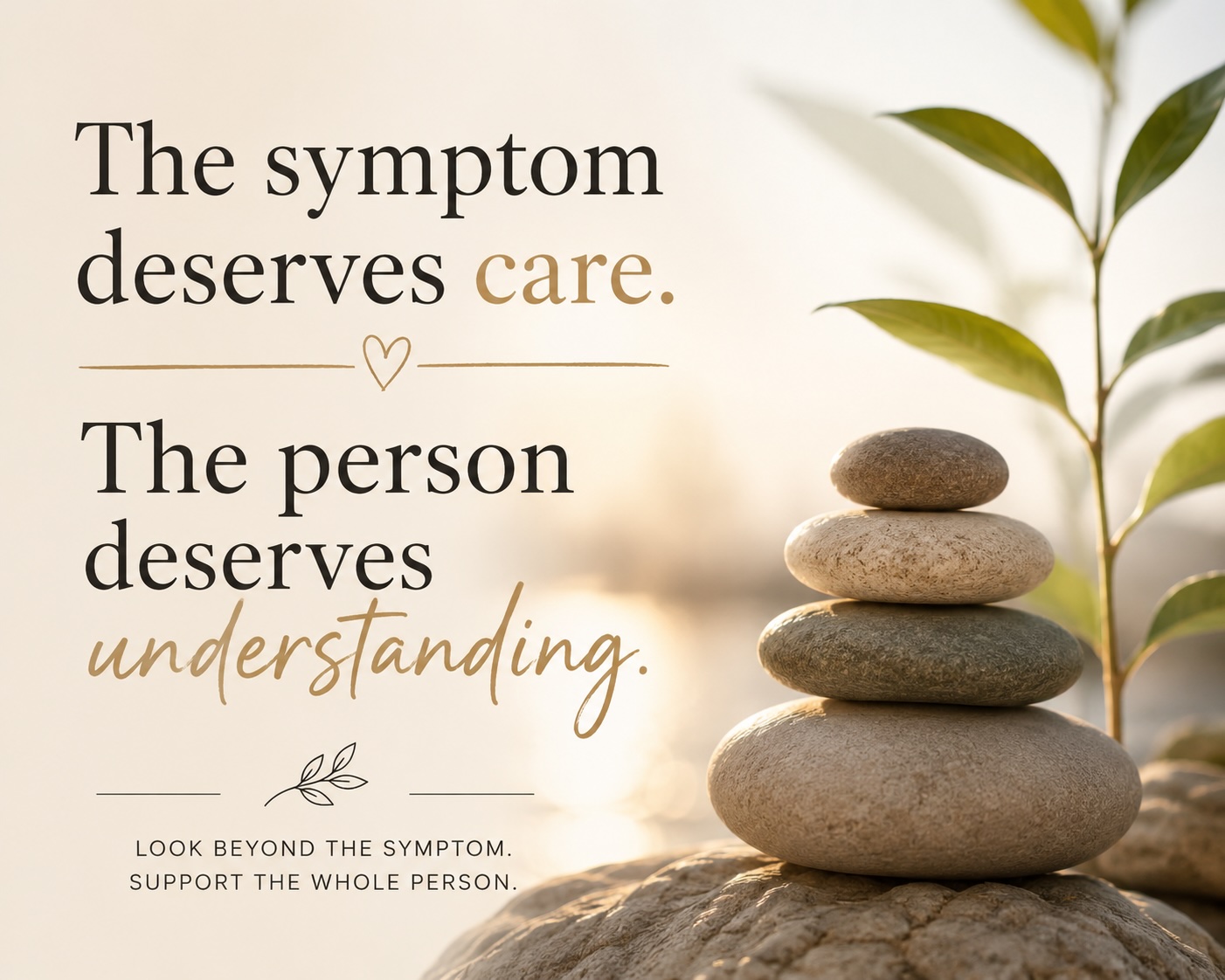
Your symptoms deserve care.
Your experiences deserve understanding.
And sometimes, looking at the whole person rather than one isolated problem can open possibilities we couldn’t see before.
Ready to Look a Little Deeper?
Sometimes the first step towards change is simply becoming curious about what may be happening beneath the surface.
If you feel ready to explore the patterns, experiences or beliefs that may be influencing where you are today, I’d be happy to have a conversation with you.