




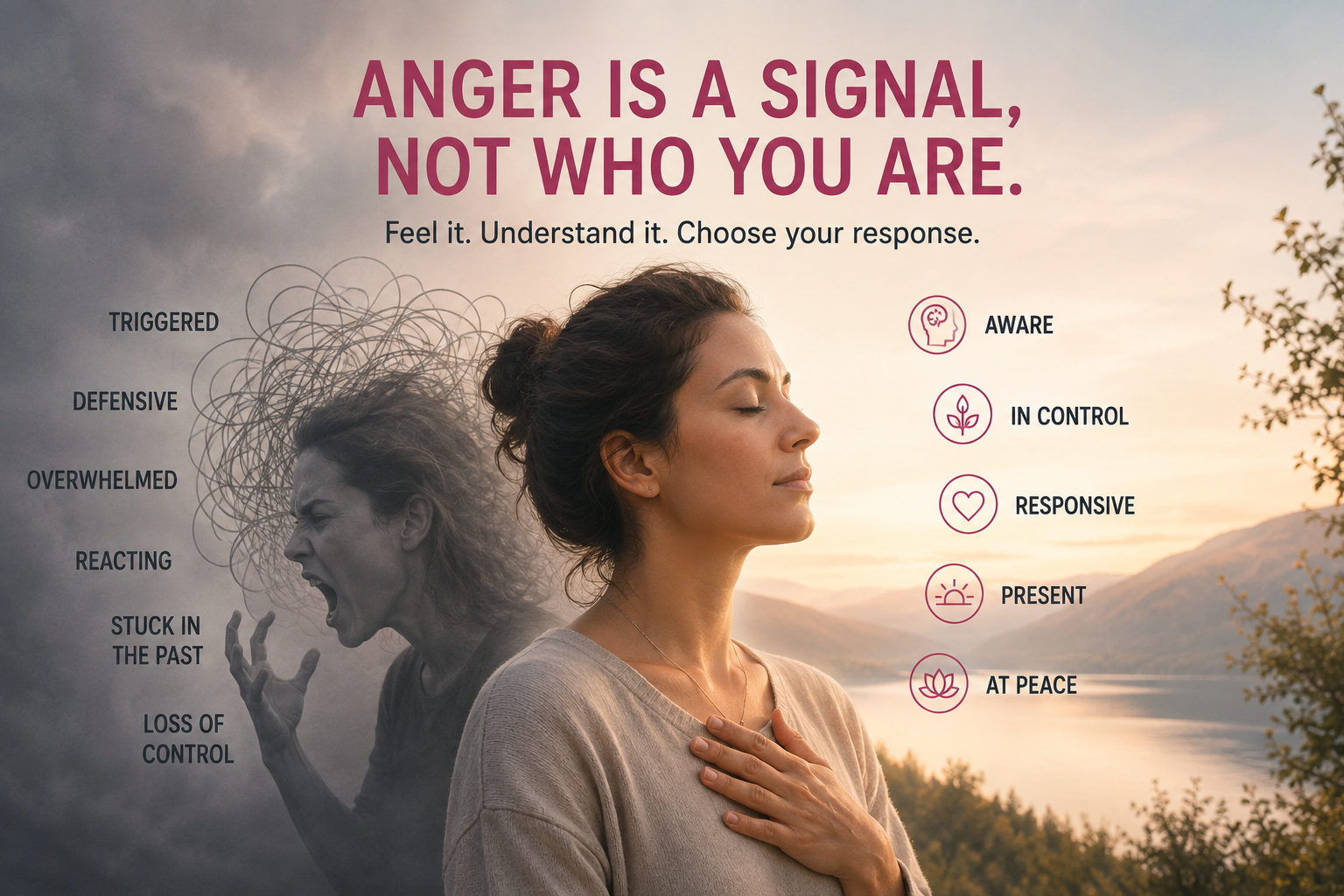
There is something interesting about anger.
In the moment we are angry, we can feel incredibly powerful.
We feel certain that we are right.
We can clearly see what the other person did wrong.
We feel justified in blaming them, confronting them or demanding an apology.
A voice inside us says:
You shouldn’t have treated me like that.
You need to understand what you’ve done.
I need to stand up for myself.
And sometimes, standing up for ourselves is absolutely necessary.
But there is an important question worth asking:
Am I responding from strength, or am I being controlled by my emotional state?
Because sometimes the moment we feel most powerful is actually the moment we have the least control over ourselves.
When Anger Makes the Problem Feel Bigger
Think about what can happen when we are triggered.
One sentence from another person can keep us awake at night.
One look can change our mood.
One comment can replay in our mind for hours.
One interaction can affect the rest of our day.
The external event may have lasted only a few seconds, yet internally we continue experiencing it long after it has ended.
When we are calm, we may be able to think:
Maybe I don’t have the whole picture.
Perhaps they didn’t mean it the way I interpreted it.
Maybe they are dealing with something I don’t know about.
Perhaps this isn’t as significant as it feels right now.
But when anger takes over, those possibilities can disappear.
Our attention narrows.
Suddenly, all we can see is:
What they did.
How they hurt us.
Why we are right.
Why they are wrong.
And the stronger the emotional state becomes, the harder it can be to see anything outside that perspective.
Your Brain Is Trying to Protect You
Anger isn’t necessarily the enemy.
It can be useful information.
Anger may tell us that a boundary has been crossed, that something feels unfair, that we feel threatened, dismissed, disrespected or unheard.
Sometimes anger gives us the energy to protect ourselves or make an important change.
The problem isn’t that we experience anger.
The problem begins when anger removes our ability to choose what happens next.
When we are highly emotional, our perception of an event can become narrower. We become more focused on the information that supports what we are already feeling.
We remember the hurtful sentence and temporarily forget the hundred kind things that person has said.
We see their mistake but struggle to see our own contribution.
We become focused on winning the argument without asking what winning might cost us.
Sometimes we can win the argument and lose something far more valuable.
Trust.
Connection.
Respect.
Or our own peace.
Reaction Is Not the Same as Strength
We sometimes confuse immediate reaction with strength.
Someone says something we don’t like, and we respond instantly.
Someone criticises us, and we defend ourselves.
Someone raises their voice, and we raise ours.
It may feel powerful because we are doing something.
But consider this:
If another person’s words can instantly determine your emotional state and your behaviour, who is actually in control?
The other person?
The anger?
Or you?
Real strength isn’t about making another person afraid of us.
It isn’t about having the final word.
And it isn’t about proving that we are right.
Real strength is being able to experience a powerful emotion without allowing that emotion to turn us into someone we don’t want to be.
The Space Between Feeling and Action
You do not have to suppress anger.
You do not have to pretend everything is fine.
And you certainly do not have to accept disrespectful or harmful behaviour.
You can set boundaries.
You can say no.
You can leave.
You can have a difficult conversation.
You can tell someone that their behaviour is unacceptable.
But there is an enormous difference between responding consciously and reacting emotionally.
When anger rises, we often feel pressure to act immediately.
Say something.
Send the message.
Prove the point.
Make the decision.
But not everything needs to be resolved in the emotional moment.
Sometimes the most powerful thing we can do is wait.
Take a breath.
Notice what is happening inside us.
And create a little space between the emotion and the action.
Because within that space, something important becomes possible:
Choice.
Three Questions to Ask Yourself When You’re Angry
The next time you notice anger building, before responding, ask yourself:
1. Is this situation really as big as it feels to me right now?
Your feelings are real, but the meaning your mind has attached to the situation may not be the only possible interpretation.
2. If I say what I want to say right now, will I be comfortable with those words tomorrow?
Words can take seconds to say and much longer to repair.
3. What matters more to me here: proving that I’m right, or creating the outcome I actually want?
That doesn’t mean allowing someone else to mistreat you.
It means becoming intentional about how you respond.
Sometimes the right response is compassion.
Sometimes it is curiosity.
Sometimes it is a firm boundary.
Sometimes it is walking away.
The important part is that you choose it.
Don’t Hand Someone Else the Keys to Your Inner Peace
There is another way to think about anger.
If someone says something and we immediately lose our peace…
If someone behaves differently from how we want and it ruins our entire day…
If someone refuses to apologise and we continue carrying the resentment…
Then, without realising it, we may have placed our emotional wellbeing in their hands.
Our peace becomes dependent on their behaviour.
I’ll be okay when they apologise.
I’ll feel better when they understand.
I’ll be peaceful when they change.
But what happens if they don’t?
True emotional freedom begins when we recognise:
Other people can influence my experience, but they do not have to determine who I become in response to it.
That is very different from suppressing emotion.
It is learning to feel deeply while still remaining connected to yourself.
Winning the Argument Isn’t Always Winning
Anger often wants victory.
It wants the other person to admit they were wrong.
It wants justice immediately.
It wants the last word.
Awareness asks a different question:
What outcome do I actually want?
Perhaps you want to repair the relationship.
Perhaps you want to be understood.
Perhaps you need to protect a boundary.
Perhaps you need to walk away.
Perhaps you simply want to stop carrying something that is hurting you.
Once you know the outcome you want, you can choose a response that moves you towards it rather than allowing the emotional intensity of the moment to choose for you.
The Strongest Person Isn’t Always the Loudest
As we develop greater self-awareness, our definition of strength can begin to change.
Strength isn’t never becoming angry.
Strength isn’t suppressing emotion.
Strength isn’t letting people treat us however they want.
Strength is being able to say:
I am angry.
I know something has been triggered inside me.
I will listen to what this emotion is telling me.
And I will still choose what I do next.
You may discover that you need to speak.
You may discover that you need to set a boundary.
You may discover that you misunderstood something.
Or you may discover that what felt enormous yesterday looks very different once your nervous system has settled.
You don’t have to win every argument.
You don’t have to respond to every provocation.
And you don’t have to give another person’s behaviour the power to determine your inner state.
Sometimes strength looks surprisingly quiet.
It is the breath before the response.
The pause before the message.
The willingness to look inward before pointing outward.
And the ability to protect something more valuable than being right:
your relationships, your values, and your inner peace.
A Final Thought
There is an old idea that captures this beautifully:
Before words leave our mouth, we have a choice over them. Once they are spoken, we have to live with what they create.
So the next time anger makes you feel powerful, become curious.
Ask yourself:
Is this anger giving me useful information, or has it started making decisions for me?
Because perhaps the greatest strength isn’t conquering another person.
It is learning to remain the author of our own response, even when powerful emotions arise.
What If Your Anger Is Trying to Show You Something?
Sometimes we know we are overreacting, but we still can’t seem to stop the reaction.
We tell ourselves to calm down.
We promise we won’t react like that next time.
And yet, when the same trigger appears, the same emotional response comes back.
That’s often because the reaction isn’t only about what is happening in the present moment.
Our responses can be influenced by unconscious patterns, past experiences, beliefs and meanings we have attached to certain situations. A comment that seems small to someone else may activate something much deeper within us.
This is where awareness becomes powerful.
Instead of simply asking, “How do I stop being angry?”, we can become curious:
“What is this reaction trying to protect?”
“What am I making this situation mean?”
“Where did I learn to respond this way?”
“And is this pattern still serving me today?”
You don’t have to fight your emotions to change your relationship with them.
Sometimes change begins by understanding what is happening underneath them.
Ready to Understand What’s Happening Beneath the Reaction?
If you notice yourself repeating emotional patterns that you understand logically but still struggle to change, this may be an opportunity to explore what’s happening at a deeper level.
Through NLP coaching, we can explore the unconscious patterns, beliefs and emotional associations that may be influencing how you respond, and help you create more choice in the moments that used to trigger an automatic reaction.
You already have the capacity to change. Sometimes you simply need the right space, questions and support to discover a different way forward.