


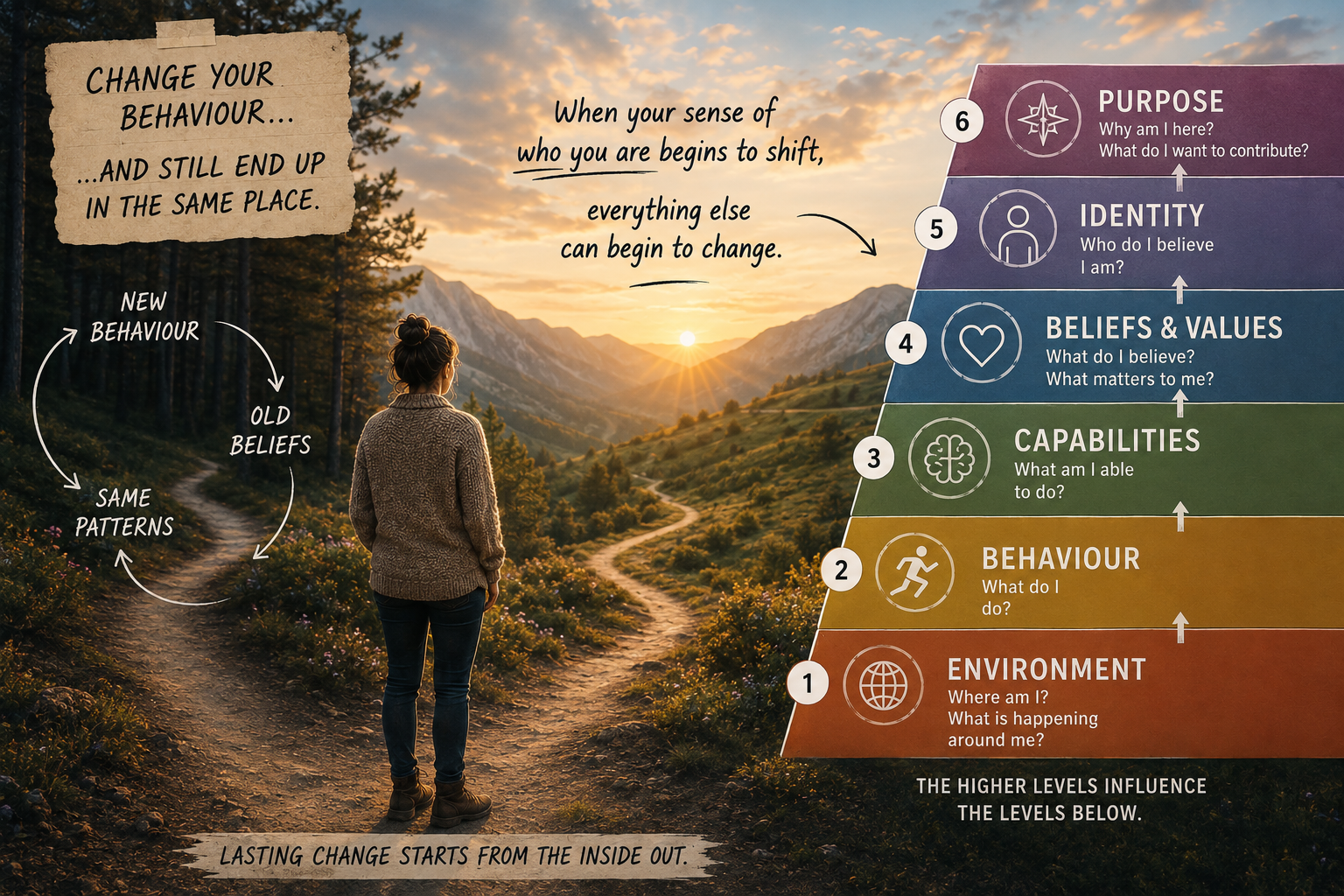
You can change your behaviour… and still end up in the same place.
You can start waking up earlier.
You can create a new routine.
You can promise yourself you’ll speak up more, set better boundaries, stop procrastinating, exercise regularly, or finally put yourself first.
And for a while, it might work.
But then somehow, slowly, you find yourself slipping back into the same old patterns.
Why?
Because sometimes the behaviour was never the deepest problem.
Change Happens at Different Levels
In NLP, there is a useful model known as Neurological Levels, often associated with Robert Dilts.
The model helps us understand that change can happen at different levels:
Environment — Where am I? What is happening around me?
Behaviour — What am I doing?
Capabilities — What am I able to do? What skills and strategies do I have?
Beliefs and Values — What do I believe? What matters to me?
Identity — Who do I believe I am?
And beyond identity, the model can also invite us to consider purpose or connection — what am I part of, and what gives my life meaning?
Each level can influence the levels below it.
And this is where change becomes interesting.
Sometimes We Try to Solve Everything at the Behaviour Level
Imagine someone who wants to become more confident.
They might tell themselves:
Speak up more.
Make more eye contact.
Stop worrying about what people think.
Say yes to opportunities.
Those are all changes in behaviour.
They may even learn new communication skills, moving into the level of capability.
But underneath all of that may still be a quiet belief:
“I’m not good enough.”
Or even deeper:
“I’m just not a confident person.”
Now we are no longer talking only about behaviour.
We are touching belief and identity.
And if I fundamentally believe, “This is who I am,” I may unconsciously interpret my experiences in ways that keep confirming that identity.
One awkward conversation becomes:
See? I knew I wasn’t confident.
One mistake becomes:
That’s just me. I always mess things up.
One rejection becomes:
I knew I wasn’t good enough.
The old identity keeps finding evidence for itself.
We Often Behave in Ways That Make Sense to Who We Believe We Are
This is why simply telling someone to “change their behaviour” doesn’t always create lasting change.
Imagine constantly trying to act like someone you don’t believe yourself to be.
It takes effort.
You might be able to maintain it for a while, but internally there can be a conflict between:
What I’m trying to do
and
Who I believe I am.
This can show up in so many areas of life.
Someone wants to set boundaries but carries the identity:
“I’m the person who keeps everyone happy.”
Someone wants to rest but believes:
“I’m only valuable when I’m productive.”
Someone wants to charge appropriately for their work but quietly believes:
“Who am I to ask for that much?”
Someone wants a healthy relationship but carries an old belief:
“I’m difficult to love.”
So they change behaviours.
They read books.
They make plans.
They try harder.
But somehow they keep finding their way back to something familiar.
Not because they are incapable of change.
But because there may be another level asking for attention.
What Happens When Identity Begins to Shift?
This is where deeper change can become possible.
Instead of only asking:
“What should I do differently?”
We can become curious about:
“What do I believe about myself that makes this behaviour make sense?”
And eventually:
“Who am I becoming?”
Imagine the person learning to set boundaries beginning to believe:
“I can care about other people without abandoning myself.”
The person afraid of speaking up begins to see:
“My voice has value.”
The person who has always described themselves as anxious begins to separate their experience from their identity:
“Anxiety is something I experience. It isn’t who I am.”
Something important changes.
The new behaviour is no longer fighting so hard against the old story.
It begins to have somewhere new to belong.
Identity Isn’t a Label We Simply Replace
This doesn’t mean standing in front of a mirror repeating:
“I’m confident. I’m successful. I’m enough.”
Identity work can be much deeper than positive affirmations.
Our beliefs about who we are may have developed through years of experiences, relationships, interpretations, successes, disappointments and protective strategies.
Some of those beliefs may once have made perfect sense.
But a belief that helped you understand yourself at 10, 20 or 30 years old doesn’t necessarily have to define who you are today.
You can become curious about it.
Where did I learn this?
What experiences have I been using as evidence?
What does this belief allow me to do?
What does it prevent me from doing?
And perhaps most importantly:
Is this still who I choose to be?
Change From the Inside Out
Sometimes changing the environment is exactly what we need.
Sometimes we need to change a behaviour.
Sometimes we simply need better skills.
And sometimes the deeper work is around our beliefs, values and identity.
There isn’t one level that is always “better” than another.
The value of Neurological Levels is that the model gives us another question to ask when change isn’t lasting:
Am I trying to solve this at the same level where I’m seeing the problem, when something deeper may also be influencing it?
Because you can spend years trying to force yourself to behave differently.
Or you can become curious about the person underneath the behaviour.
The beliefs they learned.
The identity they created.
The story they have been living from.
And the person they are now ready to become.
Perhaps lasting change isn’t only about doing something different.
Sometimes it begins when you can finally imagine:
“Maybe this isn’t who I have to be anymore.”
Ready to Explore What’s Underneath the Pattern?
If you keep finding yourself returning to the same pattern despite knowing what you should do differently, perhaps the next question isn’t:
“How do I make myself change?”
Perhaps it’s:
“What is happening underneath this behaviour?”
Through NLP coaching, we can explore the beliefs, patterns and internal stories that may be influencing the way you think, feel and respond, and create space for new choices.
You don’t have to spend your life fighting the same behaviour. Sometimes the most meaningful change begins deeper.
Schedule your free session and let’s explore what’s underneath the pattern.