
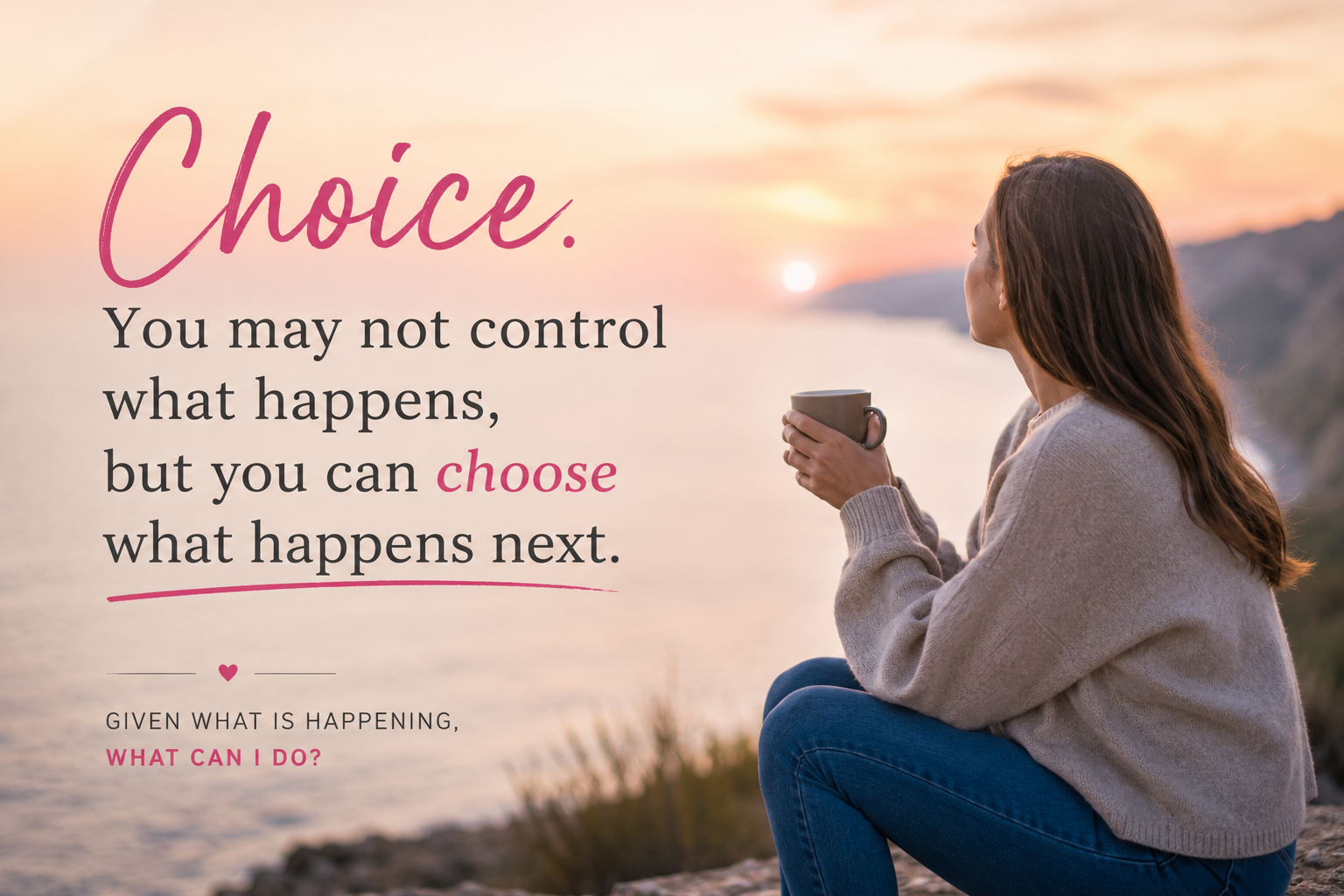
Choice.
It sounds like such a simple word.
But when life feels difficult, uncertain or outside our control, we can easily forget how much choice we still have.
Having choice doesn’t mean controlling everything that happens in your life.
It doesn’t mean pretending difficult circumstances don’t exist.
And it definitely doesn’t mean blaming yourself for things you couldn’t control.
It means recognising where you do have influence and what choices are still available to you.
In psychology, this sense that we can make choices, take action and influence what happens next is often described as agency.
But I like to think about it more simply:
What can I choose from here?
Or perhaps an even more powerful question:
“Given what is happening, what can I do?”
When We Stop Seeing Our Choices
Sometimes we genuinely don’t feel that we have choices.
Perhaps we’ve tried many times to change something and nothing seemed to work.
Perhaps we’ve experienced situations where our voice wasn’t heard, our efforts made little difference, or events repeatedly happened outside our control.
Eventually, we may stop trying.
Psychology has a term that can help us understand this: learned helplessness.
When we repeatedly experience situations where our actions seem to have little or no effect, we can begin to learn that our actions don’t matter.
And that learning can travel with us.
Even when circumstances change, we may still think:
There’s nothing I can do.
This is just how things are.
Nothing ever changes.
What’s the point?
Sometimes the absence of choice is real.
But sometimes the feeling that we have no choice remains long after more choices have become available.
That is where awareness becomes important.
Cause and Effect
In NLP, there is a concept often described as being “at Cause” or “at Effect.”
Being at Effect can look like experiencing your life as something that is primarily happening to you.
“I feel this way because they did that.”
“I can’t move forward because of what happened.”
“I’ll be okay when they change.”
“My circumstances need to change before I can change.”
Sometimes those statements contain very real truths.
Other people do affect us. Circumstances do matter. Loss, relationships, finances, health and environment can profoundly influence our lives.
Being “at Cause” doesn’t mean denying any of that.
It means asking:
Where do I still have a choice within this reality?
Perhaps I cannot change what happened.
But I can choose what I do next.
Perhaps I cannot control another person.
But I can choose my boundary.
Perhaps I cannot make someone understand me.
But I can choose how much energy I continue giving to trying.
Perhaps I cannot change the entire situation today.
But I can choose one small step.
Choice Is Not Blame
This distinction matters enormously.
There is a big difference between saying:
“This happened because of you.”
and saying:
“This happened. What choices are available to you now?”
The first can create blame.
The second creates possibility.
You can acknowledge that something was unfair.
You can acknowledge that you were hurt.
You can acknowledge that someone else’s choices affected you.
You can acknowledge circumstances that were completely outside your control.
And you can still ask what belongs to you now.
Your next decision.
Your response.
Your boundary.
Your interpretation.
Your willingness to ask for help.
Your willingness to try something different.
Your decision to stay, leave, speak, rest, learn, forgive, protect yourself or begin again.
Having choice does not mean taking responsibility for everything.
It means taking ownership of what is yours.
Sometimes the Choice Is Very Small
We often imagine change as something dramatic.
But sometimes change begins with a very small choice.
Getting out of bed.
Making the phone call you’ve been avoiding.
Saying no.
Asking for help.
Going for a walk.
Having the difficult conversation.
Choosing not to respond immediately.
Applying for something.
Writing one paragraph.
Changing one small habit.
Deciding that today you will respond differently than you did yesterday.
The action itself may seem insignificant.
But something important is happening.
You are giving yourself a new experience:
I chose.
I acted.
What I do can influence what happens next.
And repeated experiences of choice can begin to change the way we experience ourselves.
Instead of:
Nothing I do matters.
We begin to discover:
There are things I can do.
The Question I Keep Coming Back To
When life feels overwhelming, we often ask:
“Why is this happening to me?”
“Why are they like this?”
“Why can’t things just be different?”
Sometimes those questions are worth exploring.
Understanding our history and our patterns can be deeply valuable.
But there comes a point when another question may serve us better:
“Given what is happening, what can I do?”
Not:
How do I control everything?
Not:
How do I make this disappear?
Not:
Whose fault is this?
Simply:
What is available to me from here?
Sometimes the answer will be big.
Sometimes it will be one tiny action.
And sometimes the most powerful thing you can do is recognise that you have a choice you hadn’t noticed before.
You Don’t Need Control to Have Choice
Perhaps this is the part I find most important.
You don’t need control to have choice.
There will always be things outside your control.
You cannot control everything that happens to you.
You cannot control what other people think, say or do.
You cannot rewrite what has already happened.
But somewhere between what happens and what happens next, there is often a space.
A space to pause.
A space to notice.
A space to choose.
And sometimes changing your life begins by noticing that space.
So if you’re feeling stuck today, perhaps don’t ask yourself how to fix everything.
Start with something smaller:
Given what is happening right now, what can I do?
And see what comes up.
A Final Thought
If you’ve been feeling stuck, overwhelmed, or as though the same patterns keep repeating, sometimes the first step isn’t forcing yourself to change.
It’s becoming aware of where you still have choice.
In my coaching work, I help people explore the unconscious patterns, beliefs and strategies that can make certain responses feel automatic, and create space for new choices to become possible.
If you’re curious about what might be keeping you stuck, I invite you to schedule a free session and explore what could change when you begin seeing your situation differently.
And if someone came to mind while you were reading this, perhaps share this post with them.
Sometimes one question is enough to open a door:
“Given what is happening, what can I do?”